Accounts and account opening
Scenarios · This page is independent of integration method. API parameters live in the API Reference; event semantics in Events and status; the diagram is at the end of this page.
Concepts and choices
Three objects, three jobs. KYC is the entity record and decides whether the user qualifies. The currency account decides which currencies the user can hold. The virtual account is the bank-side collection account and decides where money can be sent. They are not interchangeable.
The order is fixed. The integration flow submits business KYC first, then opens a currency account, then applies for a virtual account. Each virtual account call covers one country and one currency.
KYC is asynchronous. Submitting only returns a userId; the decision arrives as EMFIN.KYC_STATUS. Omit userId in the request to create a user; pass an existing ID to update that user's business KYC, in which case every required field must be sent again.
Open currencies one by one. One currency account per currency; the call only takes userId and currencyCode. Which currencies are available depends on your merchant setup.
A virtual account needs a country and a currency. bankCountry is an ISO 3166-1 alpha-2 code and currencyCode is ISO 4217. A successful request returns vaApplicationId, the key used to match the opening result.
Lifecycle and notifications
- Upload materials. Keep the returned
fileId; KYC and additional-material requests both reference it. - Submit business KYC.
userIdin the request may be empty; the response returnsuserId, the key for every later call. Store it next to your own user ID. - Wait for
EMFIN.KYC_STATUS. Readdata.action: materials requested, decision given, or the request revoked. - Open a currency account. Send
userIdandcurrencyCode; the responsedatais empty. This version of the documentation records no callback for the endpoint, so treat the response as the result. - Apply for a virtual account. Send
userId,bankCountryandcurrencyCode; keepvaApplicationId. The response means accepted, not opened. - Wait for
EMFIN.VA_RESULT. Match it bydata.vaApplicationId; onlystatus=Sis a success. - Query the virtual account. Before collecting, confirm
statusisACTIVE; only show an available account to the payer. - Close it when needed. Wait for
EMFIN.CLOSE_VA_RESULT.
Edge cases
| Situation | What to do |
|---|---|
| KYC rejected | Do not open accounts. Fix the reason and resubmit. |
| Resubmitting KYC | It does not speed up a running review; wait for EMFIN.KYC_STATUS. |
| Updating a submitted KYC | Include userId; every required field must still be sent. |
| Virtual account without a currency account | The server rejects it; open the currency account first. |
| Several currencies for one user | One currency account per currency; each virtual account call covers one country and one currency, all linked by the same userId. |
| Collecting right after opening a currency account | You cannot. Collection needs an active virtual account; an opening response is not a collection signal. |
| Collecting on an unavailable account | Do not. The documentation only promises that an ACTIVE account can be paid into; show only accounts in that state. |
| Collecting while closing | Do not display the account during closure; wait for EMFIN.CLOSE_VA_RESULT before deciding. |
| Mixing availability with business status | Two different scales; see Events and status. |
| Wrong currency | Opening the wrong currency does not break the flow, but that account cannot collect; open another one with the right currencyCode. |
Developer view
The diagram expands the account opening chain by participant and marks the endpoint and key fields at each step.
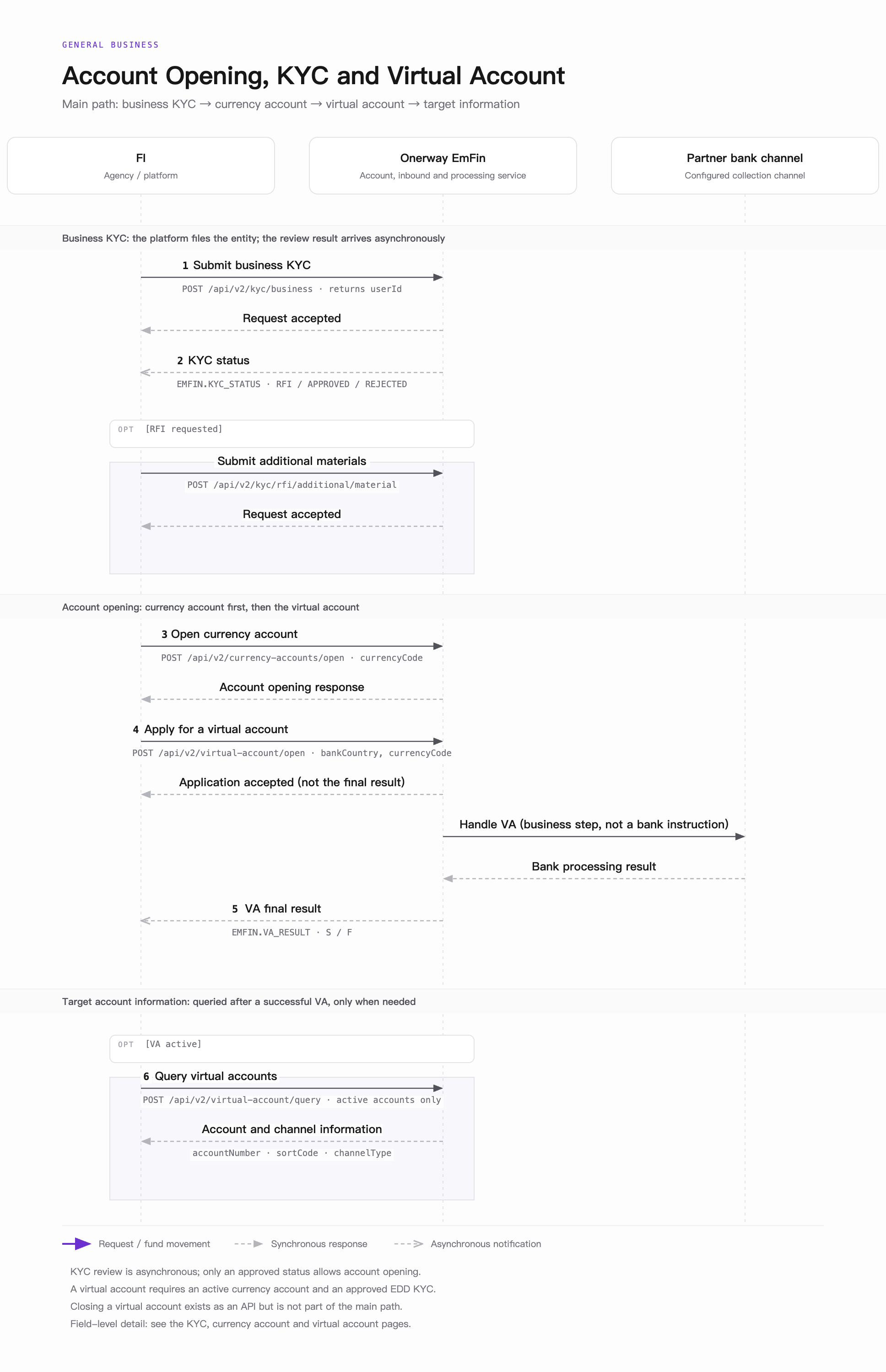
Accounts · sequence diagram
| Step | Endpoint / event | Key fields |
|---|---|---|
| Upload a file | POST /api/v2/upload/file | fileName, file; returns fileId |
| Submit business KYC | POST /api/v2/kyc/business | userId (optional), kycType, registration data, related parties |
| KYC outcome | EMFIN.KYC_STATUS | data.action, data.kycStatus, data.requestedInfomation |
| Open a currency account | POST /api/v2/currency-accounts/open | userId, currencyCode |
| Apply for a virtual account | POST /api/v2/virtual-account/open | userId, bankCountry, currencyCode; returns vaApplicationId |
| Opening result | EMFIN.VA_RESULT | data.vaApplicationId, data.status (S/F) |
| Query virtual accounts | POST /api/v2/virtual-account/query | userId; returns the account list and status |
| Close an account | POST /api/v2/virtual-account/close / EMFIN.CLOSE_VA_RESULT | userId, vaApplicationId, vaCloseReason (≤512 chars) |
Related
Overview
This section describes each business scenario — concepts, lifecycle and result notifications — independently of how you integrate. Decide what you are doing first, then which endpoint to call.
Inbound and crediting
A payer transfers money to your user. You match that payment to a specific user, and Onerway credits it internally. The inbound notice, the match and the credit result are three separate events: the notice says money arrived at the bank, the match says you linked it to a user, the result says it reached the user balance.