Inbound and crediting
Scenarios · This page is independent of integration method. API parameters live in the API Reference; event semantics in Events and status; the diagram is at the end of this page.
Concepts and choices
The inbound notice is pushed; do not poll. Its rechargeId is the key to every later action. Store it first, then decide whether to match the payment.
Matching links the payment to a user. You link rechargeId to your own userId; sourceOrderNo is optional and maps the payment to your own order. An inbound payment can be matched once; after that you cannot change its amount, currency or payer details.
Verification and review are not exposed. After the match is submitted, Onerway verifies, screens and, where required, reviews internally before crediting. You only see the acceptance response and the final credit result.
Before you start
- Inbound notice ≠ credit.
EMFIN.RECHARGEonly means the bank payment was booked; the balance changes after the match completes. - 20000 ≠ final state.
respCode=20000means the request was processed successfully (accepted); final state comes fromEMFIN.RECHARGE_RESULT. - Currency is a parameter, not a scenario. Which currencies are supported depends on the account and channel configuration; the flow does not change.
Lifecycle and notifications
- The payer transfers to the virtual account. This step does not involve your system. Only show collection details from a virtual account whose status is
ACTIVE. - Receive
EMFIN.RECHARGE. RecordrechargeId, currency, amount and payer details. Do not credit the user yet. - Submit the match
POST /api/v2/deposit/match. SenduserIdandrechargeId(both required);sourceOrderNois optional (≤64 chars). The response only says the request succeeded; the final state comes from events. - Wait for
EMFIN.RECHARGE_RESULT. Onlystatus=Sis a successful credit;Fis a failure. This is the final state. - Handle additional materials (optional). You may receive
EMFIN.TRANS_RFI; submit what it asks for. A revocation arrives asEMFIN.REVOKE_TRANS_RFI. - After the credit. The transaction ends here. Refunds are on the refunds page; settlement results are described in Events and status.
Edge cases
| Situation | What to do |
|---|---|
Matching the same rechargeId twice | Do not retry. Confirm whether the payment is already matched or credited before contacting Onerway. |
| Refunding before matching | Use the refund API. A credited payment cannot be returned through it. |
| The same notification arrives twice | Deduplicate by request_id; always answer HTTP 200 with respCode=20000. |
| Finding out where the money is | Use the last EMFIN.RECHARGE_RESULT, not arrival order. |
| Amount or currency mismatch | Do not retry with an edited amount; matching uses the amount and currency from the inbound notice. Raise an exception case with Onerway. |
| No result for a long time | Do not resubmit the match; wait for the event, or contact Onerway with the rechargeId. |
| Reassigning a credited payment | Not supported. A match is final; reassignment requires a return, after which the payer transfers again. |
Developer view
The diagram expands the same flow by participant and marks the endpoint and key fields at each step. The business description ends here.
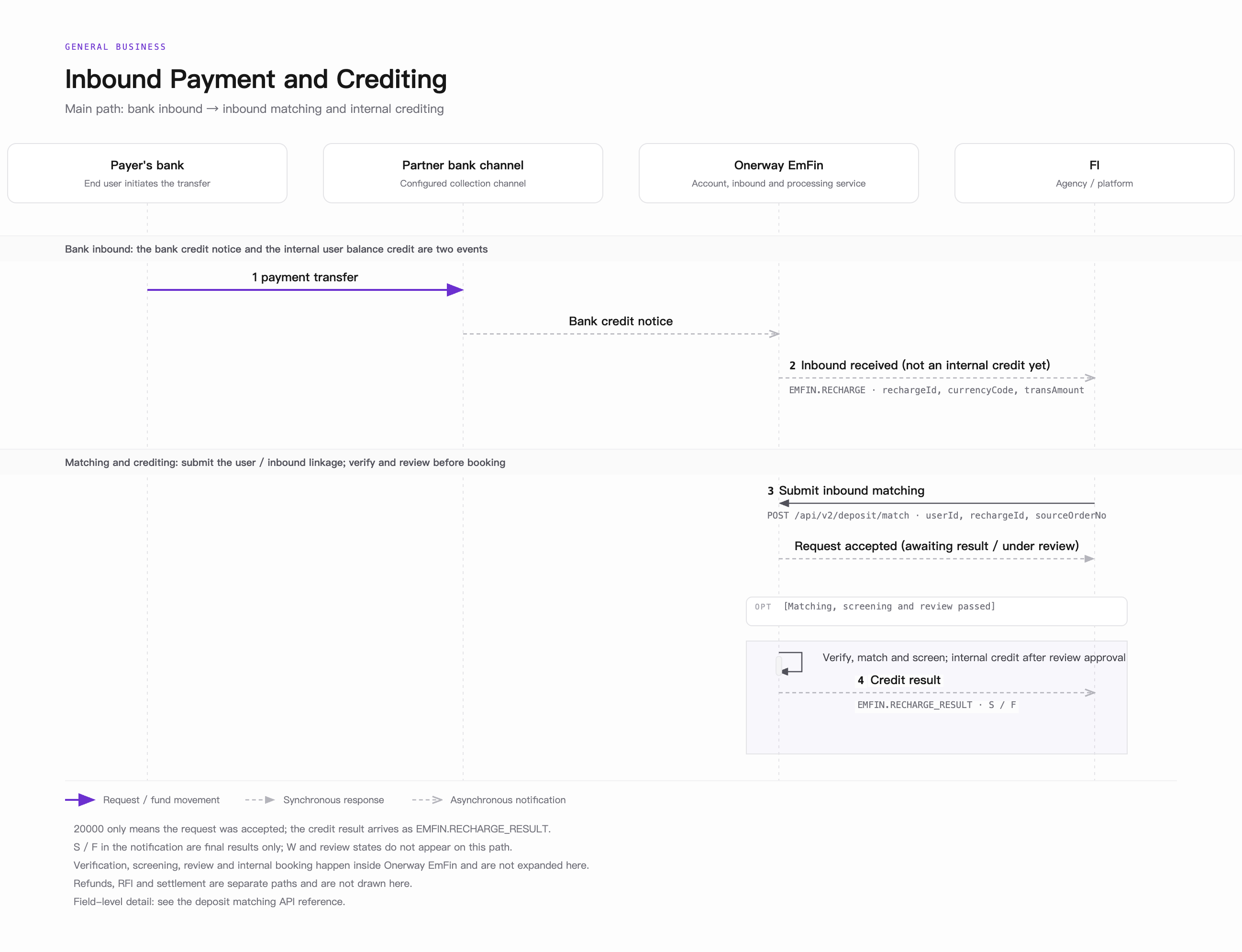
Inbound and crediting · sequence diagram
| Step | Endpoint / event | Key fields |
|---|---|---|
| Inbound notice | EMFIN.RECHARGE | rechargeId, currencyCode, transAmount, remitterName, bankTransferReference |
| Submit the match | POST /api/v2/deposit/match | userId, rechargeId, sourceOrderNo |
| Materials requested | EMFIN.TRANS_RFI | rechargeId, requestedInfomation |
| Credit result | EMFIN.RECHARGE_RESULT | rechargeId, status (S/F), failReason |
Related
Accounts and account opening
A user first has an entity record, then a currency account, then a virtual account. The three steps happen in order and cannot be reordered; each result arrives either as an event or as a synchronous response — never infer it from a submission succeeding.
Refunds and returns
While an inbound payment is still unmatched, the money can go back to the payer along the original route. Once the match succeeds, the refund API no longer applies — that is the hardest boundary on this path.